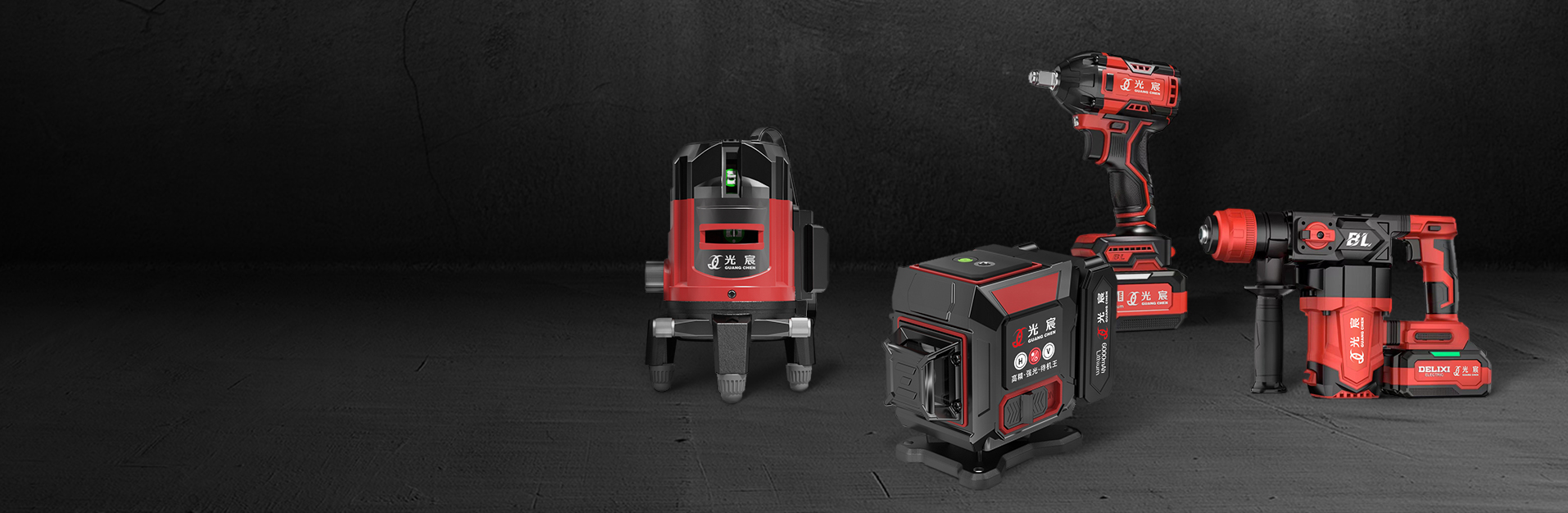
Quick Answer: A laser level is a precision tool that emits a beam of laser light to project a perfectly horizontal, vertical, or angled reference line (or point) onto surfaces. It works by passing light through a rotating prism or pendulum-stabilized diode, ensuring an accurate, level plane without manual measuring. It is widely used in construction, interior design, surveying, and DIY projects.
Content
A laser level is an advanced measuring and alignment instrument that replaces — or dramatically improves upon — the traditional spirit (bubble) level. Instead of relying on a small vial of liquid to judge levelness, a laser level uses semiconductor laser diodes to project a razor-thin, highly visible beam of light in one or more planes.
The projected line serves as a reference guide that workers, builders, and DIY enthusiasts can align objects to, ensuring accuracy across large distances without the need for chalk lines, tape measures, or a second pair of hands.
Modern laser levels range from compact, pocket-sized point-line tools to professional-grade 360° rotary systems capable of leveling an entire construction site in minutes.
Understanding the working principle of a laser level helps you choose the right model and use it correctly. The core mechanism involves three key components:
At the heart of every laser level is a semiconductor laser diode — a compact device that converts electrical energy into a concentrated, coherent beam of monochromatic light. Most consumer and professional tools use red laser diodes (wavelength: 630–680 nm) or green laser diodes (wavelength: ~520 nm). Green lasers appear up to 4× brighter to the human eye under the same power conditions, making them preferable for outdoor or bright-room use.
A laser level must be perfectly level before its projected line is accurate. There are two main methods:
The raw dot of laser light must be spread into a line or plane. This is achieved through:
Not all laser levels are created equal. The right type depends entirely on your application. Here is a structured comparison:
| Type | Projection | Typical Range | Best For | Accuracy |
| Dot / Point Laser | 2–5 reference points | Up to 30 ft | Plumb/transfer, electrical outlet alignment | ±1/8 in at 30 ft |
| Line Laser Level | 1 or 2 lines (H/V) | 30–100 ft | Tiling, cabinet hanging, picture framing | ±3/32 in at 30 ft |
| Cross-Line Laser Level | Intersecting H + V lines | 30–165 ft | Wall framing, door/window installation | ±1/8 in at 33 ft |
| 360° Multi-Line Laser | Full-room H + multiple V lines | Up to 200 ft | Room layout, drop ceilings, HVAC | ±1/16 in at 33 ft |
| Rotary Laser Level | 360° rotating single beam | Up to 2,000 ft (with detector) | Grading, foundations, large construction | ±1/16 in at 100 ft |
| Grade / Slope Laser | Adjustable angled plane | Up to 1,600 ft | Drainage slopes, road grading | ±1/16 in at 100 ft |
| Pipe Laser Level | Precise single-axis beam | Up to 300 ft | Underground pipes, sewer lines | ±1/16 in at 100 ft |
The color of a laser level beam is one of the most important buying considerations. Here is a direct comparison:
| Feature | Red Laser | Green Laser |
| Visibility | Good indoors, limited outdoors | Excellent indoors & outdoors (4× brighter) |
| Battery Life | Longer (lower power draw) | Shorter (higher power draw) |
| Cost | Lower price point | Higher price point |
| Temperature Sensitivity | More stable in cold | Can lose brightness in extreme cold |
| Best Use Case | Indoor projects, budget jobs | Bright rooms, outdoor work, large spaces |
Verdict: For most indoor residential tasks, a red laser level is sufficient and economical. For professional contractors working in well-lit spaces or outdoors, investing in a green laser level yields significantly better visibility and productivity.
A laser level is one of the most versatile tools across multiple industries. Common uses include:
When evaluating a laser level, the accuracy spec is stated as a deviation over a given distance — for example, ±1/8 inch at 30 feet. This means the projected line may deviate up to 1/8 inch from perfectly level at a 30-foot distance. The following factors affect real-world accuracy:
Selecting the correct laser level comes down to five key criteria:
For small DIY tasks (hanging art, light shelving), a basic cross-line laser level with a range of 30–50 ft is ideal. For large commercial construction projects, a rotary laser level covering hundreds of feet with a remote detector is necessary.
Outdoor environments require either a green laser level (for better visibility) or a rotary laser combined with an electronic detector, since laser beams become invisible in direct sunlight at longer distances.
Self-leveling models save significant setup time and reduce user error, making them the preferred choice for professional work. Manual leveling tools have their place in specialized applications (e.g., projecting a defined slope) but require more care and time.
Construction sites are harsh environments. Look for a laser level with at least an IP54 rating (splash-proof, dust-resistant) for general outdoor use, or IP65/67 for demanding jobsite conditions with heavy dust or rain exposure.
Most laser levels run on AA/AAA batteries or rechargeable lithium-ion packs. Rechargeable models are more economical for heavy users. Battery-powered units provide greater flexibility on sites without power access.
Yes, but visibility is the key challenge. In direct sunlight, most standard laser level beams are invisible beyond 20–30 feet. Use a green beam for better daylight visibility, or pair a rotary laser level with an electronic laser detector for long-range outdoor work. Many professional rotary models are rated for outdoor ranges of 500–2,000 feet when used with a compatible detector.
Most consumer-grade self-leveling laser levels achieve an accuracy of ±3/32 to ±1/8 inch at 30 feet. Professional-grade models improve this to ±1/16 inch at 33 feet or better. Rotary laser levels designed for surveying can achieve ±1/16 inch accuracy at 100 feet — sufficient for foundation work and large-scale leveling tasks.
These are fundamentally different tools. A laser level projects a continuous reference line or plane for alignment purposes. A laser distance measurer fires a pulsed beam, measures the time of flight (or phase shift) of the returned beam, and calculates distance. Some advanced tools combine both functions, but they serve different primary purposes.
Consumer and professional laser levels are generally rated as Class 2 or Class 3R laser products. Class 2 lasers (up to 1 mW) are generally safe because the human blink reflex protects the eye from brief accidental exposure. Class 3R (up to 5 mW) pose a low risk but should not be stared into. Never point any laser level beam toward people's eyes, reflective surfaces, or optical instruments.
For indoor use with standard working distances (under 50 feet), the naked beam is usually visible enough without a receiver. A laser detector becomes necessary when working outdoors, over distances greater than 100 feet, or when the ambient light washes out the beam. Most rotary laser levels are compatible with a matching receiver sold separately or included in professional kits.
Perform a simple wall test: set up the laser level at a known distance from a wall, mark the beam position, then rotate the unit 180° and re-mark. If the two marks don't align, the unit is out of calibration. Many manufacturers offer recalibration services, and some professional models have user-adjustable calibration screws.
The most important accessories for a laser level include: a stable adjustable tripod, a laser target/detector for outdoor work, laser-enhancing tinted glasses (to improve beam visibility in bright conditions), a wall mount bracket for hands-free operation, and a calibration/carry case for storage and transport.
A laser level is one of the most impactful upgrades any builder, contractor, or serious DIYer can make to their toolkit. By replacing the guesswork of manual measurement with a precise, self-leveling beam of light, these tools dramatically reduce errors, speed up workflows, and improve finished quality across virtually every construction and installation task.
Whether you need a compact cross-line laser level for hanging artwork or a professional-grade rotary laser level for grading a job site, understanding how these instruments work — from the laser diode and self-leveling pendulum to the optical beam projection system — empowers you to select the right tool and use it to its full potential.
Invest in the appropriate type for your use case, maintain it well, and a high-quality laser level will deliver years of reliable, accurate performance on every project.
Copyright 2023 Jiangsu Guangchen Electronic Technology Co., Ltd. All Rights Reserved
China Lithium Power Tools Supplier


 English
 русский
 Español
 عربى
عربى