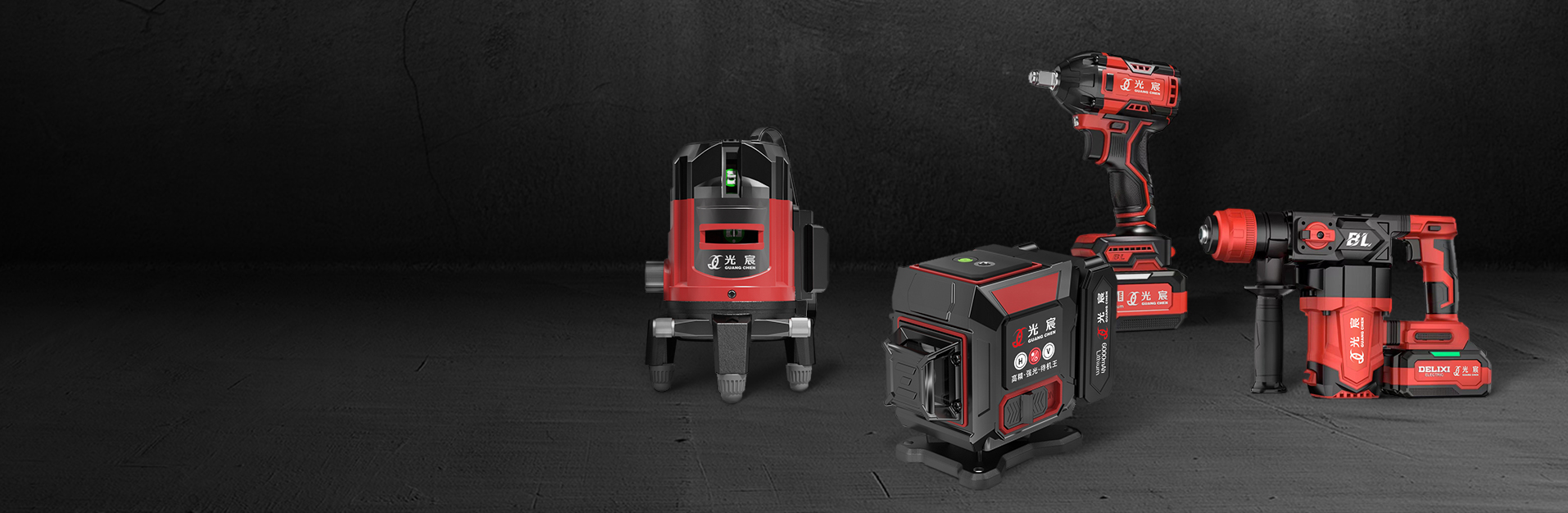
Quick Answer: There are 7 main types of laser levels currently available in the market: Dot (Point) Laser Levels, Line Laser Levels, Cross-Line Laser Levels, Rotary Laser Levels, 3D / Multi-Line Laser Levels, Grade / Slope Laser Levels, and Pipe Laser Levels. Each type is engineered for a distinct set of tasks — from small interior DIY jobs to large-scale outdoor grading and underground pipe installation. The global laser level market was valued at approximately USD 590.7 million in 2024 and is projected to reach USD 944 million by 2034, growing at a CAGR of 4.8%, reflecting just how indispensable these tools have become across construction, surveying, and interior design.
Content
A laser level is an optical instrument that projects a visible laser beam to create a precise horizontal, vertical, or angled reference line or point across a surface or space. Choosing the wrong type for a job does not just slow things down — it can introduce costly alignment errors, require expensive rework, or simply fail to reach the distances required on a large outdoor site.
Line laser levels dominate the market with approximately 38–40% of global market share, followed by rotary lasers at roughly 25%, torpedo/specialty types at 20%, and dot lasers at around 15%. Construction accounts for over 46.5% of all laser level usage, followed by surveying, interior design, plumbing, and HVAC installation. Despite this market dominance of line lasers, no single type is universally "best" — the right laser level depends entirely on the task, environment, and required accuracy.
This guide breaks down every major type of laser level currently sold, how each one works, what it is best used for, its typical accuracy and range, and how it compares to the alternatives — so you can make an informed purchasing or specification decision.
A dot laser level is the most basic type, projecting one or more laser dots onto a surface as precise reference points. Rather than a continuous line, it emits pinpoint spots — typically in combinations of 1, 3, or 5 dots — used to transfer level or plumb points between floor, walls, and ceiling.
The most common configuration is the 5-point dot laser, which simultaneously projects one point directly overhead (plumb up), one directly below (plumb down), and one on each of the four walls at exactly 90° to each other. This makes it ideal for transferring layout points between floors in multi-storey construction, aligning columns, and establishing perfectly square room layouts.
Line laser levels are the most widely sold type — holding approximately 38–40% of the global market — because they project one or more continuous straight laser lines across walls, floors, or ceilings for fast, accurate alignment tasks.
A standard line laser projects either a horizontal line, a vertical line, or both. The line is produced by passing a laser beam through a cylindrical lens that fans the beam out into a flat plane, creating a line that can stretch across an entire wall. Most modern line lasers are self-leveling, using a magnetic pendulum or electronic servo mechanism that automatically compensates for slight tilts of up to ±3° to ±5°, eliminating the need for manual adjustment.
Red vs. green line lasers: Red beam line lasers are more affordable and suitable for most indoor work. Green beam line lasers are approximately four times brighter to the human eye and significantly more visible in well-lit environments, making them the preferred choice for large indoor spaces and semi-outdoor applications.
A cross-line laser level simultaneously projects both a horizontal and a vertical laser line, creating a cross or "plus sign" pattern on the wall — making it one of the most versatile tools for interior fit-out work.
The cross-line is a direct evolution of the single-line laser. The intersection of the horizontal and vertical lines creates a precise reference point that allows operators to align both level and plumb references at once. Many cross-line lasers also include a plumb dot (pointing up and/or down), adding point transfer capability to the line-projection feature. Most models include a mode selector allowing the operator to use the horizontal line only, the vertical line only, or both together.
A rotary laser level is the go-to tool for large-scale outdoor levelling tasks — it spins a single laser dot at speeds of up to 1,200 RPM, creating the visual effect of a continuous 360° horizontal or vertical plane of laser light.
Unlike line lasers, which project a fixed beam in one direction, the rotary laser sweeps its beam around the full 360° perimeter of a room or site. This allows a single setup point to serve as a level reference in every direction simultaneously. When used with a laser receiver (detector), rotary lasers can work over distances of 300–1,600 ft (90–500 m) even in bright daylight, making them the dominant tool on large construction sites, driveways, foundations, and outdoor sports fields.
Rotary lasers dominated the construction laser market segment with revenue reaching approximately USD 1.22 billion in 2023, expected to exceed USD 1.86 billion by 2032, driven by large-scale infrastructure projects globally. Most professional rotary lasers are self-leveling within a range of ±5°, with higher-end models offering remote control operation and integrated tilt sensors.
3D laser levels — also called multi-plane or 360° line laser levels — are the most advanced and comprehensive type available for interior fit-out work, projecting full 360° horizontal and vertical laser planes that cover all four walls, the floor, and the ceiling simultaneously.
While a standard cross-line laser projects its lines across one wall in front of it, a 3D laser level fans its beams to wrap completely around the room. A typical 3-plane (3×360°) laser level projects one 360° horizontal plane and two 360° vertical planes set at 90° to each other. This gives the operator a complete square grid reference covering the entire room from a single setup, enabling fast, accurate layout for partition framing, flooring, tiling, and suspended ceilings. An even more advanced variant — the 4D laser level (4×360°) — adds a second horizontal plane and two vertical planes for even greater layout flexibility in complex interior environments.
Common configurations include: 8-line, 12-line, and 16-line models, with the 12-line model (3×360°) the most widely used. Almost all 12-line and 16-line models use green laser beams for maximum visibility across the full room.
Grade (slope) laser levels are specialised rotary lasers that can be intentionally tilted to project a precise, programmable slope angle — making them the essential tool for drainage, road construction, and grading projects.
A standard rotary laser level self-levels to perfectly horizontal (0% grade). A grade laser goes further: it allows the operator to programme a specific slope percentage or angle, then holds that slope precisely across the full 360° sweep. Single-grade lasers apply a slope in one axis (e.g., along the length of a driveway). Dual-grade lasers can apply independent slopes on both the X and Y axes simultaneously — critical for complex drainage systems, car park grading, and athletic field construction where water must drain in a controlled direction across a two-dimensional surface.
Pipe laser levels are a highly specialised type designed exclusively for aligning underground pipes, utility conduits, culverts, and tunnel bores at precise grades — a task that no other type of laser level can perform effectively in confined, underground conditions.
A pipe laser is a compact, self-levelling instrument that is placed inside the pipe or at the pipe invert (bottom) and projects a laser beam along the centreline of the pipe run. The contractor uses the laser beam as a reference to ensure that each successive pipe section is laid at exactly the correct grade and alignment. Most pipe lasers are remotely controlled from above ground (via a display panel or Bluetooth app), eliminating the need to enter the trench to make adjustments. They are designed with waterproof housings (IP67 or IP68) and can function in the wet, muddy conditions typical of underground utility work.
The table below provides a quick reference across all seven laser level types, covering their key specifications, primary applications, and typical price ranges to help you identify the right tool at a glance.
| Type | Projection | Typical Range | Accuracy | Indoor / Outdoor | Best Application | Price Range |
| Dot / Point | 1–5 laser dots | Up to 100 ft | ±1/8 in at 33 ft | Indoor | Point transfer, column alignment | $30–$150 |
| Line | 1–2 straight lines (H or V) | 50–165 ft | ±1/8 in at 33 ft | Indoor | Tiling, cabinet installation, trim | $30–$200 |
| Cross-Line | H + V lines simultaneously | 65–165 ft | ±1/8 in at 33 ft | Indoor / semi-outdoor | Partitions, drywall, fixtures | $40–$250 |
| Rotary | 360° spinning beam (H or V) | 300–1,600 ft | ±1/16 in at 100 ft | Indoor & Outdoor | Large slabs, foundations, sites | $150–$2,000+ |
| 3D / Multi-Line | 3–4 × 360° planes (8–16 lines) | 50–165 ft | ±1/16 in at 33 ft | Indoor | Full room layout, ceiling grids | $80–$500 |
| Grade / Slope | 360° beam at programmable grade | 300–2,000 ft | ±1/16 in at 100 ft | Outdoor | Road grading, drainage, carparks | $500–$3,500+ |
| Pipe Laser | Centreline beam at set grade | Up to pipe run length | ±1/16 in per 100 ft | Underground | Sewer, drain, conduit installation | $1,500–$8,000+ |
Table 1: Complete comparison of all 7 types of laser levels by projection type, range, accuracy, environment, application, and price.
Across all seven types of laser levels, every model is available in either a red or a green beam variant — and the choice significantly affects performance, especially outdoors or in bright environments.
| Factor | Red Laser Level | Green Laser Level |
| Wavelength | ~650 nm | ~520 nm |
| Visibility to Human Eye | Standard | ~4x brighter |
| Indoor Performance | Good | Excellent |
| Outdoor / Bright Light Performance | Poor without receiver | Good (requires receiver for long range) |
| Battery Consumption | Lower | Higher (~20–30% more) |
| Typical Price Premium | Base price | +20–50% over red equivalent |
| Best Suited For | Dimly lit interiors, low-budget DIY | Bright interiors, semi-outdoor, professional use |
Table 2: Red vs. green laser beam comparison across visibility, battery use, price, and suitability for different environments.
There is also an emerging blue LED laser level category, primarily used in low-cost consumer tools. Blue-light LED laser levels are suitable for basic DIY and crafts, but their accuracy and brightness are significantly inferior to diode-based red and green laser levels and are not recommended for construction or professional applications.
Beyond the seven types defined by their projection pattern, all laser levels also fall into one of two levelling mechanism categories: self-leveling or manually leveled. This distinction is critical to purchasing decisions across every type.
For professional use across any of the seven types of laser levels, a self-leveling model is always recommended. Typical self-leveling accuracy for professional tools is ±0.1 mm/m (about ±1/16 inch per 50 ft), which is achievable from a stable tripod setup.
Matching the laser level type to the specific job requirement — rather than buying the most expensive model available — is the key to both performance and value. Use the decision framework below:
Q1: How many types of laser levels are there in total?
There are 7 primary types of laser levels available in the current market: dot/point, line, cross-line, rotary, 3D multi-line, grade/slope, and pipe laser levels. Within these 7 types there are further sub-categories — for example, single-grade vs. dual-grade slope lasers, or 8-line vs. 12-line vs. 16-line 3D lasers — bringing the total number of distinct configurations to well over a dozen.
Q2: Which type of laser level is most popular?
Line laser levels hold the largest market share at approximately 38–40% of global laser level sales, according to 2024 market data. They are popular because they are compact, affordable ($30–$200), easy to use, and suitable for the vast majority of interior levelling, tiling, and alignment tasks. Rotary lasers are the dominant type on professional construction sites by revenue, accounting for over $1.22 billion in sales in 2023.
Q3: What is the most accurate type of laser level?
Professional-grade rotary laser levels and grade laser levels are the most accurate, with top models achieving ±1 mm accuracy at 30 m (±1/16 inch at 100 ft) or better. Survey-grade pipe lasers also achieve similarly high accuracy in their specific underground alignment application. Consumer line and cross-line lasers typically achieve ±1/8 inch at 33 ft (±3 mm at 10 m), which is sufficient for interior work but not for engineering-grade applications.
Q4: What type of laser level is best for outdoor use?
Rotary laser levels are the best type for outdoor use, because they produce a high-power 360° beam that can be detected by a laser receiver at distances of 300–1,600 ft even in direct sunlight — conditions that make standard line and cross-line laser dots completely invisible. For outdoor grading and slope work, a grade / slope laser level with receiver is the purpose-built choice.
Q5: What is a 3D laser level, and how is it different from a cross-line laser?
A 3D laser level (also called a multi-plane or 360° line laser) projects its laser lines across all four walls, floor, and ceiling simultaneously by projecting complete 360° planes — rather than single-direction lines like a cross-line laser. A standard cross-line projects a horizontal and vertical line on one wall in front of the device. A 3D laser covers the entire room at once, making it dramatically faster for full-room layouts. Common 3D configurations include 8-line (2×360°), 12-line (3×360°), and 16-line (4×360°) models.
Q6: Do I need a laser receiver (detector) for every type of laser level?
Not for every type. Line, cross-line, and 3D laser levels are designed for indoor use where the beam is visible to the naked eye — no receiver is needed. Rotary, grade, and pipe laser levels require a receiver for outdoor work, because the rotating beam is invisible in direct sunlight beyond ~30–60 ft (10–18 m) without one. A receiver detects the beam electronically and gives a visual and audible indication of the exact level position, extending the working range to 300–2,000 ft (90–600 m).
Q7: What is the difference between a single-grade and dual-grade slope laser?
A single-grade slope laser tilts the laser plane along one axis only (e.g., from one end of a site to the other), suitable for simple ramps, driveways, and basic drainage channels. A dual-grade slope laser can independently tilt on both the X and Y axes simultaneously, allowing a programmed slope in two directions at once. This is essential for car parks (which must drain to corner catchpits), athletic fields, and complex drainage systems where water needs to flow in a precisely controlled two-dimensional direction.
Q8: Are laser levels replacing traditional spirit levels and optical levels?
For most professional applications, yes. Laser levels are significantly faster, can be operated solo, and cover greater distances than spirit levels or optical dumpy levels. The global laser level market growing from USD 590.7 million in 2024 to a projected USD 944 million by 2034 — a CAGR of 4.8% — reflects this steady replacement trend across construction, real estate, surveying, and interior design. Traditional spirit levels still have a place for quick on-site plumb and level checks, but for layout and alignment work, laser levels have become the professional standard.
The market today offers 7 distinct types of laser levels — each purpose-designed for a different working environment, distance range, and accuracy requirement. From the simple dot laser used to transfer a single reference point between floors, to the high-precision dual-grade rotary laser that grades a multi-acre construction site to within millimetres, the breadth of options can be overwhelming — but each type has a clear, logical application.
For most contractors and serious DIY users, a high-quality 3D green-beam line laser level ($120–$300) will handle the majority of interior tasks, while a professional rotary laser level ($400–$1,000) with receiver covers outdoor and large-site needs. Users who only need one tool that bridges both should look at premium cross-line models with extended range and green beam technology as the most versatile single investment.
As the laser level market continues to grow — driven by construction expansion, urbanisation, and the integration of Bluetooth, app connectivity, and self-leveling technology — the range of types of laser levels will continue to expand. Understanding the fundamental categories covered in this guide ensures that any investment — whether a $40 DIY tool or a $3,000 survey-grade instrument — is the right one for the job.
Copyright 2023 Jiangsu Guangchen Electronic Technology Co., Ltd. All Rights Reserved
China Lithium Power Tools Supplier


 English
 русский
 Español
 عربى
عربى