English
 русский
 Español
 عربى
عربى
If you are comparing a green laser vs red laser level, the short answer is: green is brighter and easier to see in daylight or over long distances, while red is cheaper and lasts longer on batteries. The laser color does not change leveling accuracy in a well-made self-leveling instrument. Your choice should be driven by the job site, visibility requirements, and total cost of ownership.
A laser level is a measuring tool that projects a visible straight line or dot pattern onto a surface, allowing you to mark level lines, plumb points, and right angles without a spirit level. It is widely used for installing shelving, setting door frames, laying tile, building partition walls, and aligning machinery.
Content
Green vs Red Laser Levels: The Main Differences
The real trade-off is visibility versus cost: green lasers are far easier to see in bright conditions and over longer distances, but red lasers are cheaper, more power-efficient, and often have longer runtimes.
| Characteristic | Green Laser Level | Red Laser Level |
|---|---|---|
| Wavelength | 505–550 nm | 610–670 nm |
| Perceived brightness | Up to 4 times brighter than red | Baseline for comparison |
| Typical indoor range | 30–60 m (class dependent) | 15–30 m (class dependent) |
| Outdoor visibility | Workable in shade and overcast; still needs a detector in sun | Limited in sun; usually needs a detector |
| Power consumption | Higher | Lower |
| Battery life | Shorter (often 4–8 h) | Longer (often 10–20 h) |
| Price | Higher | Lower |
| Accuracy | Same as red for equal class | Same as green for equal class |
Visibility and Brightness
Green light appears much brighter to the human eye, especially in mixed lighting. This is because the eye is most sensitive to wavelengths near green, while red light is perceived as dimmer at the same output power.
Working Range
Green lasers have a longer usable working range without a receiver. In indoor hallways, a green beam often stays visible for 30 m or more, whereas a red beam may fade after 15–20 m depending on the unit’s power class.
Power Consumption and Battery Life
Green laser modules consume more energy to produce the same visible output, so you can expect shorter battery life. A green unit may run 4–8 hours on a rechargeable battery while a comparable red unit runs 10–20 hours.
Price
Green laser levels carry a clear price premium. The complex green laser diode module and additional power management increase the manufacturing cost, meaning the retail price is usually 30–50% higher than an equivalent red model.
Accuracy and Stability
Accuracy is not affected by laser color. Both green and red units are available in the same accuracy classes, typically ±1/8 inch per 30 ft or better for self-leveling instruments; the internal pendulum and calibration determine accuracy.
Which Laser Level Should You Choose for Your Work?
Pick green for bright or outdoor sites and for long sight lines; pick red for indoor jobs, budget projects, and situations where battery runtime matters more.
- Green laser level is ideal for: renovation in sunlit rooms, patios, decks, framing, plumbing rough-ins, and any job where a visible beam over 10 m or more is needed.
- Red laser level is ideal for: interior finishing, cabinetry, dropped ceilings, electrical conduit, and jobs where a nearby wall or floor line is enough.
- Use a green model in large open basements or commercial spaces where you work in daylight from windows and skylights.
- Choose red if you need a backup tool, have a hard budget limit, or value longer operating time on a single charge.
For technique and calibration, this guide on how to use the laser level correctly explains the difference a solid setup makes.
Practical Buying Considerations for Laser Levels
Focus on four factors when comparing specific models: beam color, line configuration, self-leveling range and accuracy, and battery system.
Line Configuration
Choose the projection pattern that matches your tasks. A 2-line unit projects one horizontal and one vertical line, which is sufficient for hanging pictures, installing cabinets, and simple plumbing checks. A 3-line unit adds a vertical line on another axis, making it easier to transfer points across a room. A 5-line unit covers multiple vertical and horizontal planes, useful for drywall framing, door installation, and general construction. 8-line, 12-line, and 16-line models add more planes and are aimed at complex applications like ductwork or full-wall layout.
For straightforward indoor projects, a 2-line green laser level provides a clear beam at a reasonable price. If you need to align points on two walls and the ceiling, a 3-line green laser level is the practical middle ground. For jobs in bright daylight or large rooms, a 5-line green laser level with a stronger beam and wider fan angle is the better investment.
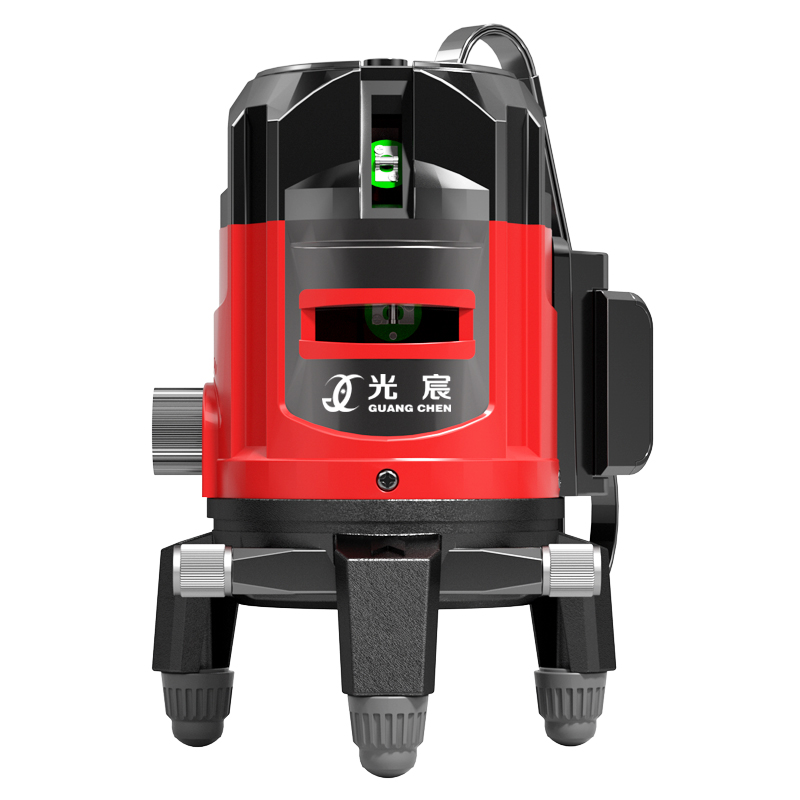 Custom High Precision 5-Line Green Laser Level Manufacturers, FactoryJiangsu Guangchen Electronic Technology Co., Ltd is a China custom high precision 5-line green laser level manufacturers and factory, we ...View Product →
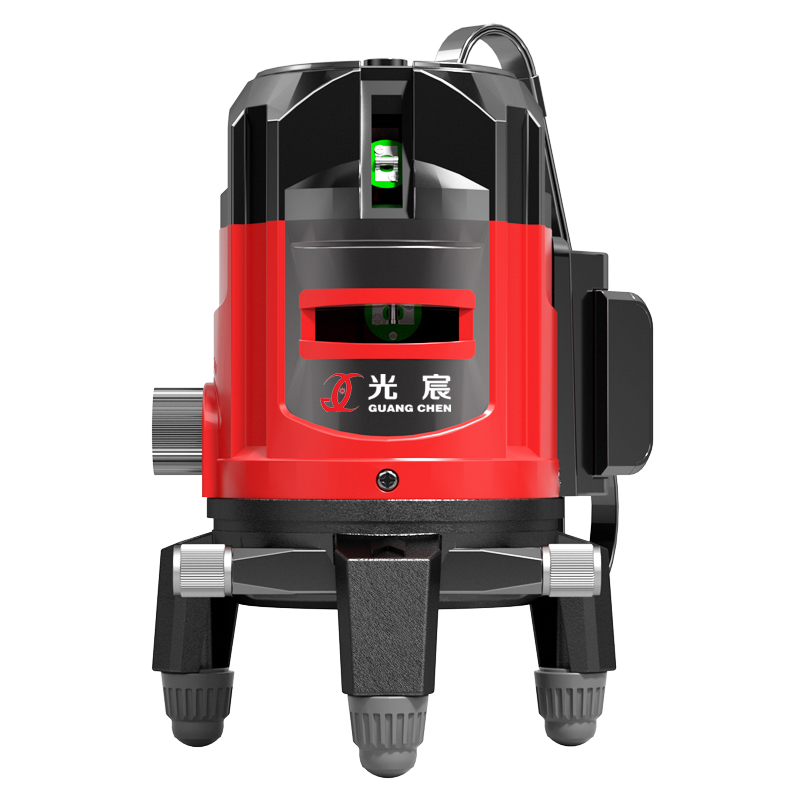 Custom High Precision 3-Line Green Laser Level Manufacturers, FactoryJiangsu Guangchen Electronic Technology Co., Ltd is a China custom high precision 3-line green laser level manufacturers and factory, we ...View Product →
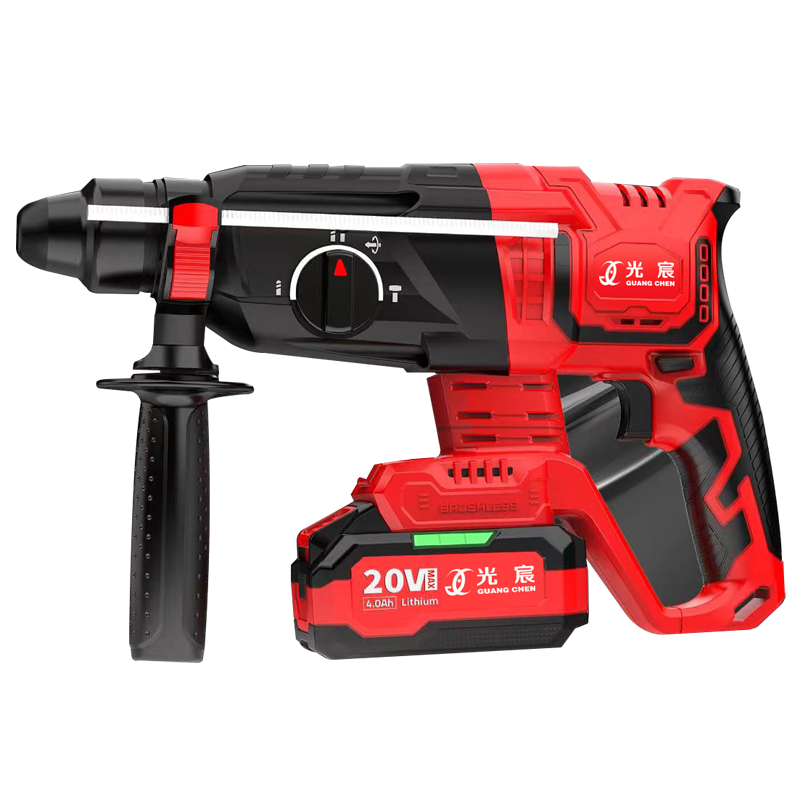 Custom High Precision 2-Line Green Laser Level Manufacturers, FactoryJiangsu Guangchen Electronic Technology Co., Ltd is a China custom high precision 2-line green laser level manufacturers and factory, we ...View Product →
Self-Leveling and Accuracy Class
Always check the self-leveling range and accuracy rating before buying. A self-leveling range of ±3° to ±4° is common, and accuracy of ±1/8 inch per 30 ft is acceptable for most renovation and construction work.
Battery System
Green units use more power, so look for models with a rechargeable lithium battery or a compatible external power port. Red units are more forgiving, and many can run on standard alkaline batteries for a long time.
FAQs: Green Laser vs Red Laser Level
Are green laser levels more accurate than red laser levels?
No. Beam color has nothing to do with measurement tolerance. A green and a red laser level of the same accuracy class will produce the same leveling result; brightness only affects how easily you see the line.
Do green laser levels use more battery?
Yes. Generating green light demands more power, so green units typically have shorter runtime than equivalent red units. Many green units rely on larger battery packs or charging systems to compensate.
Can green laser levels be used outside in sunlight?
Green lasers work better than red in shade and cloudy conditions, but in full sun even a green beam disappears over long distances. For outdoor grading or long wall alignment, combine either color with a laser detector/receiver.
Why are green laser levels more expensive?
The manufacturing process for green laser diodes or frequency-doubled crystals is more complex than for standard red diodes. This directly raises component cost, which is why green units carry a premium.
Bottom Line: Green or Red Laser Level?
Choose green if your work regularly takes you into bright rooms, outdoor patios, or long corridor layouts. Choose red if you need a lower price and longer battery life for typical indoor tasks. Buyers who do only occasional leveling at home can save money with red; professionals who level all day in changing light should invest in green.
Always pair your choice with the correct line configuration and a tripod or mount. With the right setup, both colors make your layout faster, straighter, and more reliable.