

 English
 русский
 Español
 عربى
Industry news
Home / News / Industry news / Framing Laser Level Guide: Line Counts, Accuracy and Layout Setup Steps
A framing laser level is a self-leveling line laser that projects one level plane and one or more plumb planes across a room, so plates, studs and soffits can all be marked from a single datum instead of being re-measured wall by wall. The short answer: a 3-line laser handles most wall framing, a 12-line 3D unit is the practical ceiling for whole-room fit-out, and anything above that only earns its price on repeated commercial bays.
The gain is not raw accuracy — a decent 4 ft spirit level is accurate enough for a bottom plate. The gain is that one person can hold a reference across 8 to 12 metres, mark three walls without walking back to the same corner, and repeat the same height in the next room without re-measuring. What a laser cannot do is fix an out-of-square floor or compensate for bowed lumber, which is why the cross-check steps later in this guide matter as much as the tool itself.
Content
A framing laser level replaces the string line and the repeated spirit-level checks during layout — it does not replace checking the material you are about to fix.
Inside the housing, a pendulum-mounted laser diode self-levels within a working range of roughly plus or minus 3 to 4 degrees. Push past that range and the beam blinks or cuts out, which is exactly what you want on a floor with a visible fall: the tool refuses to give you a bad line. Once settled, the horizontal plane becomes your height datum, and the vertical planes become your corner and stud references. Typical housings carry a 1/4"-20 thread for a small tripod and a 5/8"-11 thread or a magnetic bracket for steel studs and ceiling tracks.
A line laser is not the same tool as a rotary laser. A rotary sweeps a single plane through 360 degrees and is normally read with a detector outdoors, which makes it excellent for long pad and slab work. A line laser throws intersecting planes, which is what you need for corners, plumb studs and soffit returns. For framing interiors, the intersecting planes win; for site set-out over 40 metres, the rotary does.
Line count is the first specification worth settling, because a laser with too few vertical planes forces you to rotate the housing mid-layout and lose your reference.
| Configuration | Typical framing use | Where it stops being enough |
|---|---|---|
| 2-line (1 level, 1 plumb) | Transferring a single height, checking one wall, setting a door head | No second vertical, so corners need manual squaring |
| 3-line (1 level, 2 plumb at 90 degrees) | Wall corners, plumb corner studs, soffit lines on three walls | Fourth wall needs a re-set |
| 5-line (1 level, 4 plumb) | Four walls at once, room-height layout | Single height only |
| 8-line (2 level, 4 plumb) | Two heights plus corners, drop ceilings with a trim line | Awkward in tight corridors |
| 12-line (three 360-degree planes) | Whole-room fit-out: floor, walls and ceiling datum together | Slower to set up for one short wall |
| 16-line (four vertical planes plus levels) | Multi-room runs, ceiling grids, repeated commercial bays | Overkill and heavier on batteries for domestic jobs |
For a two-person crew framing partitions, the 3-line configuration is the sensible default: one horizontal for the plate and two verticals at 90 degrees give you both sides of a corner from one position.
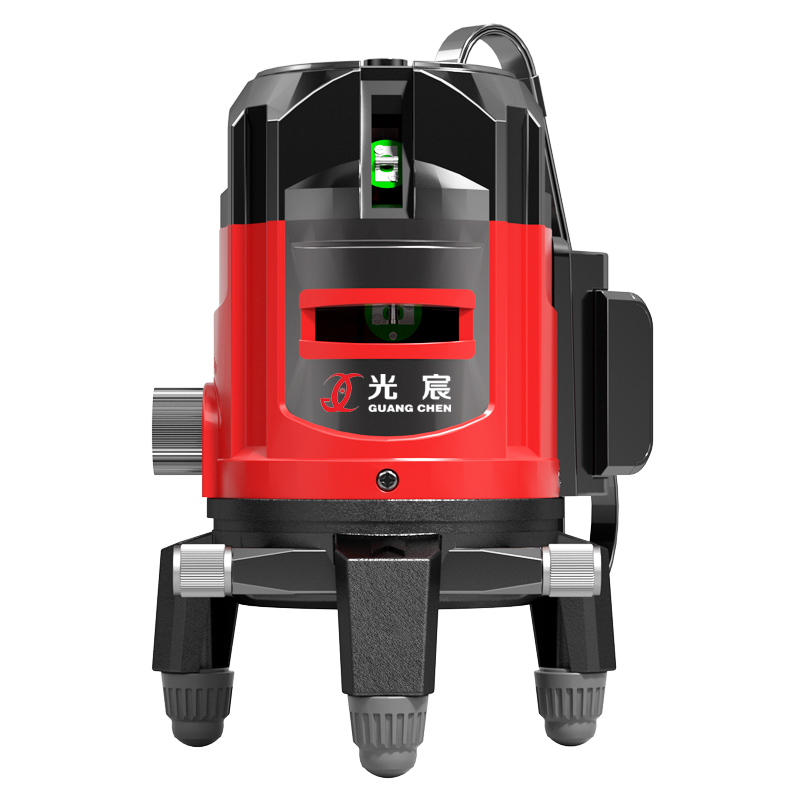 3-Line Laser Level for Partition FramingProjects one horizontal and two vertical lines for corner framing, with automatic leveling and a ±3° out-of-range warning; a practical default for two-person crews.View Product →
Move up only when you find yourself rotating the housing more than twice per room, which is the clearest sign the line count is too low for the work you take on.
Accuracy figures are quoted per distance, so read them against the tolerance you are building to rather than against each other.
| Specification | Typical framing-grade value | Practical effect on site |
|---|---|---|
| Accuracy | Plus or minus 1/8 in at 30 ft (about 2 mm per 10 m) | Well inside normal framing tolerance over a 20 ft wall |
| Budget-unit accuracy | Plus or minus 1/4 in at 30 ft | Visible drift on long soffit runs; cross-check before nailing |
| Self-leveling range | 3 to 4 degrees | A sloping floor can use up most of the range before you start |
| Working range | 15 to 30 m indoors; 40 to 60 m with a detector | Outdoor plates and long corridors need pulse mode and a receiver |
| Ingress protection | IP54 | Handles dust and light drizzle, not a dropped-in-a-puddle tool |
Framing tolerances are usually looser than the tool: a wall plumb within 1/4 in over 8 ft is commonly accepted, and a plate within 1/8 in of the datum is generous work. That means a mid-range laser is accurate enough; what separates a good purchase from a frustrating one is beam visibility and mounting stability, not the third decimal place of the accuracy claim.
A green beam is easier to see indoors than a red one at the same power class, but in direct sunlight neither colour survives past a few metres without a detector.
Set the datum first, then the plane, then the marks — reversing that order is the most common cause of a room that is level but not square.
The sequence is the same one used with a string line and a spirit level; the laser simply removes the second pair of hands. A short refresher on plane setup and re-checks is worth ten minutes before a first fit-out: how to use a laser level correctly.
Once layout moves from one wall to a full room or a corridor of repeated bays, more planes save time because the housing stops moving.
A 12-line unit puts three planes at 90 degrees to each other, so floor datum, wall plumb and ceiling trim can all be read without re-setting. That is where the extra lines pay for themselves: a two-storey fit-out with six rooms re-set maybe eight times with a 3-line unit and twice with a 12-line.
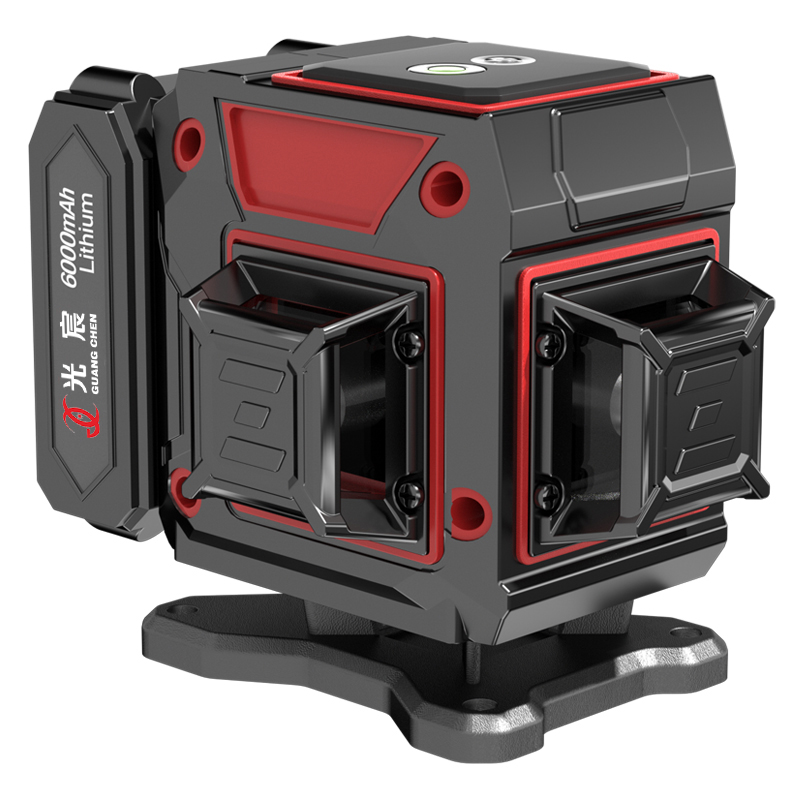 12-Line Laser Level for Multi-Room Fit-OutProjects four horizontal and eight vertical lines, enabling floor, wall and ceiling references from one setup; useful for multi-room fit-out work with fewer re-sets.View Product →
Sixteen lines suits repetitive commercial work — partition runs, suspended ceiling grids, service risers — where the same datum is carried through several spaces in a morning. The cost is weight, battery draw and setup fuss on small jobs, so treat it as a production tool rather than a general-purpose one.
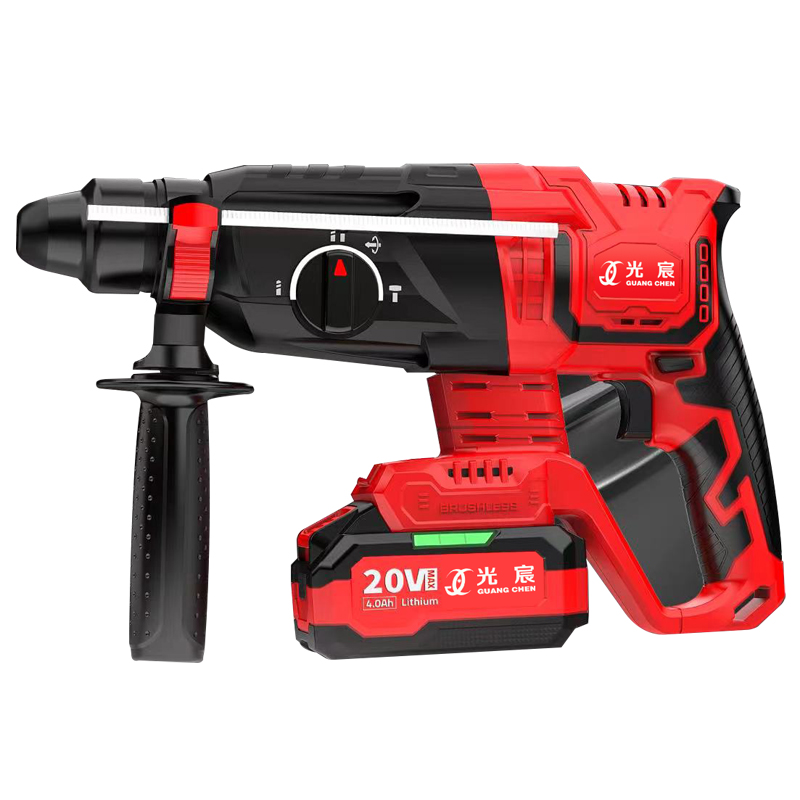 16-Line Laser Level for Commercial LayoutProjects an eight-by-eight line grid for wall, floor and ceiling positioning; suited to repetitive commercial work where the same datum carries across multiple spaces.View Product →
The full laser level range covers 2, 3, 5, 8, 12 and 16-line models, which makes it easier to match the tool to the work instead of buying the largest unit available.
Most laser-level complaints trace back to mounting and calibration rather than to the electronics, so those are the two things to specify carefully.
Yes, but only with a receiver and pulse mode for anything beyond a few metres. Direct sunlight washes out both green and red beams, so the detector does the reading and the laser becomes a rotating or sweeping reference.
For individual walls and corners, yes. For a full basement layout where several partition walls and a soffit meet, a 5-line or 12-line unit reduces re-sets noticeably, because the fourth wall no longer requires moving the housing.
After any drop, after transport in a cold vehicle, and at the start of a large job. The check takes a couple of minutes against two fixed marks and prevents a whole day of layout being repeated.
No. It replaces the string line and repeated height transfers. Spirit levels, tapelines and diagonal measurements are still how you verify that the frame you built matches the reference the laser gave you.
Buy for the layout you actually do: a 3-line laser with solid mounting and a clear green beam will out-perform a 16-line unit that wobbles on a borrowed tripod. Check the projected angle, the declared accuracy per 10 m, the self-leveling range and whether pulse mode is included — those four details decide whether the tool saves time or quietly adds a re-check to every wall.

Copyright 2023 Jiangsu Guangchen Electronic Technology Co., Ltd. All Rights Reserved
China Lithium Power Tools Supplier