English
 русский
 Español
 عربى
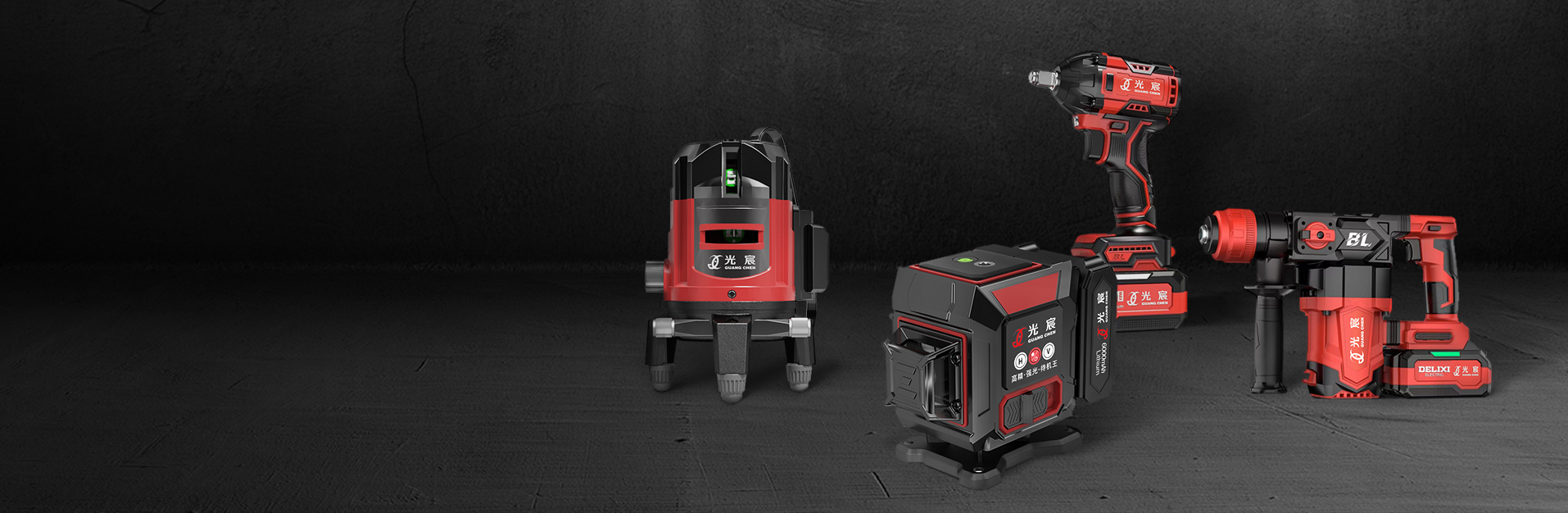
Short answer: a construction rotary laser level is a self-leveling instrument that spins a laser beam through a full 360 degrees, projecting one continuous horizontal or vertical reference plane across an entire site. A contractor-grade unit holds roughly plus or minus 1/16 inch per 100 feet, self-levels within about plus or minus 5 degrees, reaches 800 to 2,000 feet outdoors when paired with a detector, and carries an IP66 rating or better. For grading, formwork, slabs and long runs of ceiling grid, it is the fastest way to put one elevation on everything at once.
Rotary levels are bought on capability rather than styling: accuracy per 100 feet, working range with a detector, rotation speed, self-leveling range and sealing class. Those five numbers decide whether a unit saves you an hour a day or quietly creates rework. The sections below explain what each figure means in practice, when a rotary laser is the wrong tool, and how to verify a unit before you accept delivery.
Content
- What a construction rotary laser level actually does
- The specifications that decide whether it survives a real site
- Rotary, line, or both: matching the tool to the task
- Line counts, explained: matching the beam to the job
- Accuracy, tolerance and drift: the numbers that cause rework
- A repeatable setup routine that keeps the plane honest
- Procurement risks worth controlling before you order
- Frequently asked questions
What a construction rotary laser level actually does
It replaces the spirit level, the string line and a second pair of hands with a single rotating reference plane that every point on site can be measured against. A motorised head spins a laser diode at a controlled speed, and the beam sweeps a level circle around the tripod. Indoors and at dusk you can see the beam directly; in daylight the beam is invisible to the eye, which is why rotary lasers are almost always used with a handheld detector that converts the beam into an audible tone and a digital readout of how far the receiver sits above or below the plane.
Where the tool earns its cost:
- Setting pad and footing elevations across a large footprint without repeated setup.
- Checking formwork heights and screed levels ahead of a concrete pour.
- Laying out ceiling grid, duct runs and sprinkler lines at a constant height.
- Establishing falls of 1 to 2 percent in drainage and paving using slope mode.
- Providing a plumb reference for columns and partition walls on horizontal and vertical models.
A horizontal-only unit is cheaper and simpler; a horizontal and vertical model does walls, columns and partitions from the same setup. If you also need to shoot an angled line for ramps or drainage, buy a unit with manual single-axis or dual-slope entry rather than tilting the tripod.
The specifications that decide whether it survives a real site
The two columns below are the practical dividing line between a light-duty unit bought for occasional work and one that will still hold tolerance after a season of site use.
| Specification | Light-duty band | Contractor band | What it changes on site |
|---|---|---|---|
| Accuracy | Plus or minus 1/8 inch per 100 ft | Plus or minus 1/16 inch per 100 ft or better | Sets how far you can work before accumulated error exceeds your tolerance |
| Working range with detector | 300 to 600 ft | 800 to 2,000 ft | Long pads, trench runs and road profiles need the longer beam |
| Self-leveling range | Plus or minus 3 degrees | Plus or minus 5 degrees or more | How much tripod fiddling you avoid on graded or frozen ground |
| Rotation speed | Fixed, around 300 rpm | Selectable, 0 to 600 rpm or higher | Slow for long-range detector work, fast for bright indoor scanning |
| Sealing class | IP54 | IP66 or IP67 | Dust, rain and wash-down survival on an open site |
| Beam and planes | Red beam, horizontal only | Red or green, horizontal plus vertical plane | A vertical plane lets one setup handle both levels and plumb work |
| Power | Alkaline cells only | Rechargeable pack with alkaline backup | Full-day runtime without a supply run mid-shift |
Rotary, line, or both: matching the tool to the task
Choose rotary for anything outdoors, long-range or elevation-based; choose a line laser for interior work where you need several planes at once. A rotary laser wins on range and on single-plane elevation work: excavators, graders, kerb lines, pipe runs and large slabs. Its beam diverges with distance and it gives you one plane at a time, which is exactly what elevation work needs and exactly what interior layout does not.
A 360-degree line laser projects several lines at once, so a ceiling grid, a partition corner and a wall tile line can all be checked from one position without moving the instrument. The trade-off is range and outdoor visibility. If your work is a mix of site and fit-out, the realistic answer for most contractors is a rotary unit for the groundworks and a multi-line laser for everything after the roof goes on.
 16-Line Self-Leveling Laser Level for Interior Fit-Out ProjectsCreates a three-dimensional grid for wall, floor, and ceiling positioning, useful for multi-trade fit-out where one benchmark height is shared.View Product →
On large fit-out projects the higher line counts cover a whole floor from a single setup, which is why a 16-line self-leveling laser is usually specified when several trades share one benchmark height.
Line counts, explained: matching the beam to the job
Line count is a coverage decision, not a quality one: more lines simply means fewer repositioning moves. A 2-line or 3-line laser gives you one horizontal and one or two vertical lines, which is enough for tiling a wall or setting a single stud run. Five and eight line units add floor and ceiling planes plus intersecting verticals, so a room can be squared and levelled in one pass, which is the usual choice for electrical, plumbing and partition work in residential fit-out.
Twelve and sixteen line models project enough planes to work across a corridor or a full commercial floor plate, and they are the practical pick when a single benchmark height has to be shared by several trades working at once. Before you buy, list the number of surfaces you need to reference simultaneously; if the answer is four or fewer, a smaller unit will do the same job with less to set up.
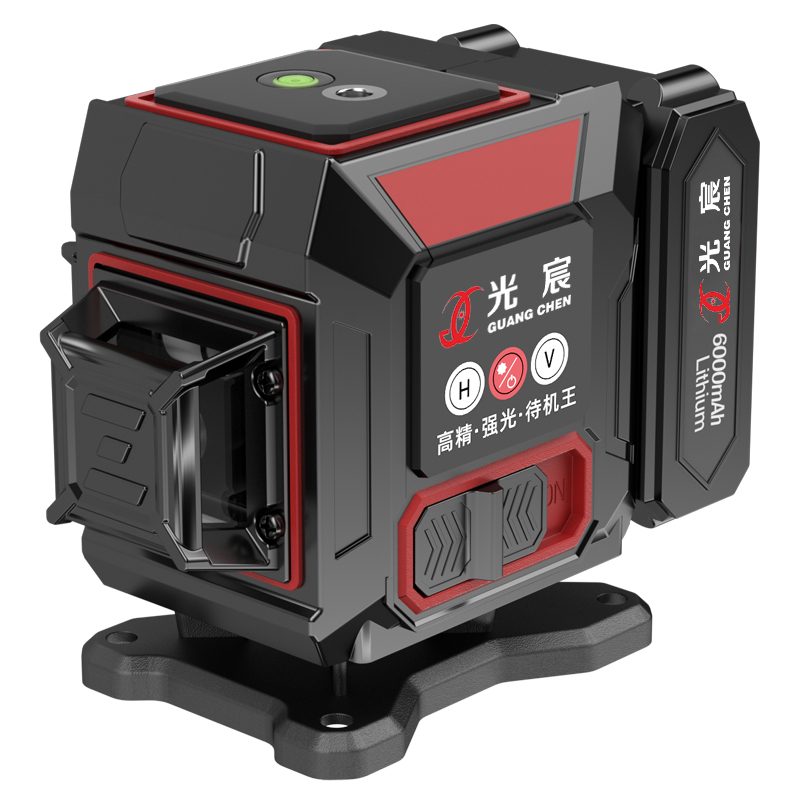 8-Line Self-Leveling Laser Level for Room-Scale Fit-OutProjects four horizontal and four vertical lines for room-scale alignment, balancing coverage and easy transport for partition, window, and MEP layout.View Product →
For most room-scale fit-out, an 8-line self-leveling laser hits the sweet spot between coverage and setup time, and it stays easy to carry between floors.
Accuracy, tolerance and drift: the numbers that cause rework
A rotary laser is only as good as its last calibration check, and the error you should plan for is cumulative, not constant. At plus or minus 1/16 inch per 100 feet, the practical tolerance is plus or minus 1/8 inch at 200 feet and roughly plus or minus 3/8 inch at 600 feet. That is fine for a drainage fall or a fence line, and marginal for a machine-set screed rail. Write the tolerance you actually need into the method statement before you choose the instrument, not after.
Three factors move a rotary laser off its plane: a knocked tripod, temperature shock after the unit is carried out of a warm cab, and simple drift over long sessions. A field check takes about ten minutes: set the instrument roughly midway between two points 100 feet apart, mark the beam height on both, rotate the head 180 degrees, and re-mark. If the two marks disagree by more than your tolerance, the unit needs service. Let the instrument acclimatise for 15 to 20 minutes before critical work, and re-check the plane whenever the tripod is bumped. The background behind these checks is covered in this explanation of how a laser level maintains its accuracy and stability.
A repeatable setup routine that keeps the plane honest
Set up the same way every time and most accuracy complaints disappear. The sequence below takes about five minutes on firm ground.
- Place the tripod on stable ground, legs spread wide and plate roughly level by eye.
- Fit the instrument on the 5/8-inch thread, tighten firmly, and confirm the base is sitting flat.
- Power on and let the self-leveling system settle; wait for the level indicator to stop flashing.
- Check the tripod has not shifted after leveling, since the unit locks out when it detects movement.
- Switch to a slow rotation speed for detector work at long range, and a faster speed for short-range scanning.
- Record the beam height at a known benchmark so every trade on site is working to the same elevation.
Procurement risks worth controlling before you order
Most rotary laser problems are specification mismatches rather than manufacturing faults. The four items below cover the majority of returns and disputes.
- Quoted range versus usable range: a headline 2,000 feet figure often assumes a detector in ideal conditions, so ask for the outdoor range with the receiver you intend to use.
- Battery reality: check whether the claimed runtime is measured with the beam on at full rotation speed, and confirm a spare pack or alkaline option is available.
- Calibration paperwork: ask what the accuracy specification refers to, and whether a certificate or a documented field-check procedure comes with the unit.
- Accessories: tripods, detectors and mounting brackets are frequently sold separately, and a missing detector turns a 1,000-foot instrument into a 100-foot one.
Frequently asked questions
Can a rotary laser level be used indoors?
Yes, but range is not the issue indoors; it is that the beam is a single plane. A rotary unit is useful for setting a constant height across a large interior, while multi-line lasers are usually faster for wall and ceiling layout.
Do I really need a detector?
For any outdoor work in daylight, yes. The rotating beam is invisible to the eye beyond a short distance, and a detector is what converts the beam into a usable grade reading.
How accurate is accurate enough?
Match the instrument to the tightest tolerance in the method statement, then add margin. For general groundworks, plus or minus 1/8 inch per 100 feet is usually sufficient; for machine-controlled or screed-rail work, specify 1/16 inch or better.
How often should the unit be recalibrated?
Annually for regular use, and immediately after any drop or transport shock. Between services, run the two-point field check described above before critical pours.
A construction rotary laser level is a tolerance tool, not a gadget, so buy the accuracy, range and sealing class your work actually demands, then protect that investment with a fixed setup routine and a periodic field check. If you also handle interior fit-out, pairing a rotary unit with a multi-line laser covers both ends of the job with one benchmark height.