English
 русский
 Español
 عربى
عربى
A concrete laser level is a self-leveling instrument that projects a level plane of light across a work area, so formwork, screed rails, anchor bolts and slab edges can be set by eye instead of by string line and spirit level. The term covers three tools on a real pour: a line laser for interior layout and short throws, a rotating laser paired with a receiver for wide slabs and outdoor grading, and a transmitter feeding a laser screed for machine-controlled floors.
The short answer first. For a basement slab, wall and column forms, or embeds inside a building, a self-leveling line laser rated near ±0.2 mm/m, roughly 1/16 in at 30 ft, handles almost everything. For a large exterior pad poured in daylight, that line laser is the wrong tool: a fan-shaped beam fades somewhere between 40 and 60 ft in bright sun, and you want a rotating beam plus a detector. On a laser screed, the laser is not a layout aid at all; it is a machine-control reference that keeps the screed head on plane while the machine drives across the bay.
Content
What the Instrument Is Actually Doing
Line lasers and rotating lasers differ mainly in how the beam is spread, not in how accurately they measure level. A line laser passes the beam through a cylindrical lens or cone prism, projecting one horizontal plane and one or more vertical planes onto floors, walls and forms. A rotating laser spins a prism at 300 to 600 rpm, sweeping the whole site, which is why a detector can pick it up beyond 100 ft while the naked eye loses it at 30 ft in sunlight.
Self-leveling is the feature that separates a usable tool from a toy on site. Most instruments compensate within ±3° to ±5°; past that range the beam blinks or shuts off and the tripod must be leveled by hand. It matters on concrete because a 0.1° tilt at the instrument is worth roughly 1/8 in of elevation error at 60 ft, so a lock-and-warn function is more valuable than a large display.
Visibility, not accuracy, is what usually limits the work. Red 635 nm diodes are inexpensive and readable at 30 to 50 ft indoors, while green 520 nm diodes appear about four times brighter, which is how a green line laser stays readable at 80 ft in a shaded interior. Neither color survives direct sun, and concrete adds three more failure modes: fine dust splitting the beam at the aperture, vibration from a pump truck or walk-behind screed, and glare from wet concrete swallowing thin lines.
The Three Classes of Laser Used on Concrete Work
Concrete work uses three classes of laser instrument, and they are not interchangeable; picking the wrong class is the most common and most expensive mistake.
| Class | Typical level accuracy | Working range | Where it fits | Main limitation |
|---|---|---|---|---|
| Line laser level (2 to 16 lines) | ±0.2 to ±0.3 mm/m | 30 to 80 ft indoors | Interior slabs, wall and column forms, sleeves, embed plates, fit-out layout | Fan-shaped beam disappears in sunlight; limited reach |
| Rotating laser with receiver | ±0.1 to ±0.3 mm/m | 100 to 1,000 ft with a detector | Exterior pads, driveways, footings, grading, long runs of formwork | Needs a detector and usually a second person; vertical work is awkward |
| Transmitter with laser screed | Machine-control tolerance across a full bay | Whole slab bay, 360° | Large industrial floors placed by laser screed | Capital cost and setup; not a handheld tool |
Matching a Line Laser to the Pour
For interior concrete and layout, buy by line count rather than by accuracy, because line count decides coverage while the accuracy figure barely changes across a product family.
A 3-line laser projects one horizontal plane and two vertical planes, enough to set a level line around a basement slab, mark door head heights, and square a single room. It is the least expensive configuration that still does real concrete work.
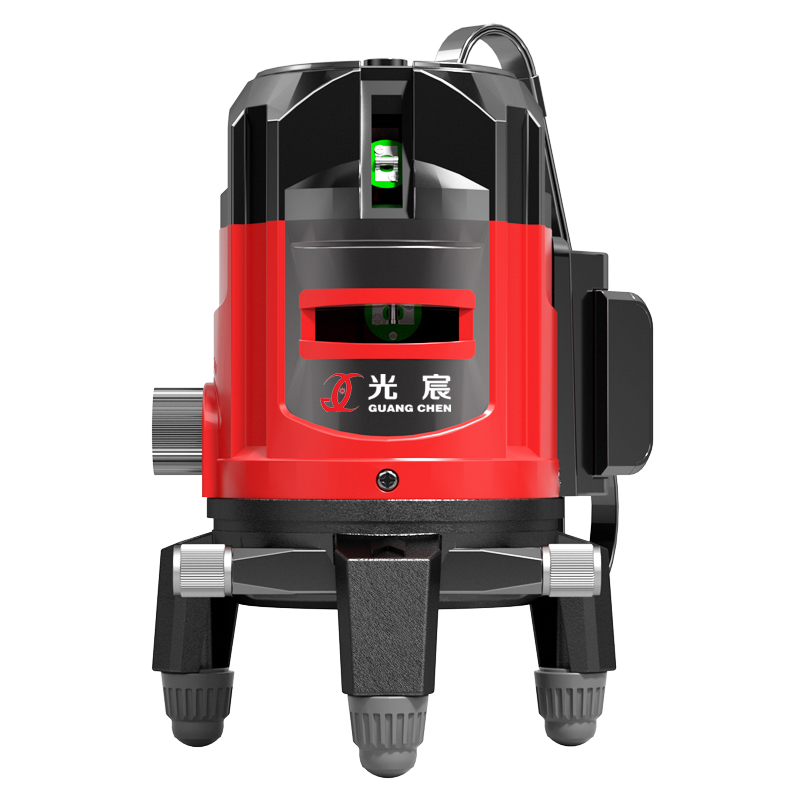 3-Line Self-Leveling Laser Level for Concrete and Interior LayoutProjects one horizontal and two vertical planes with three enhancement points, suited to basement slab level lines, door head heights, and single-room squaring.View Product →
A 5-line or 8-line unit adds a second vertical plane and a floor plumb point, so partitions, columns and sleeves can be set from one setup instead of two. Where the pour covers several rooms or a whole floor plate, a 12-line unit gives three complete 360° planes plus plumb points above and below, which keeps an operator from re-setting the tripod at every wall.
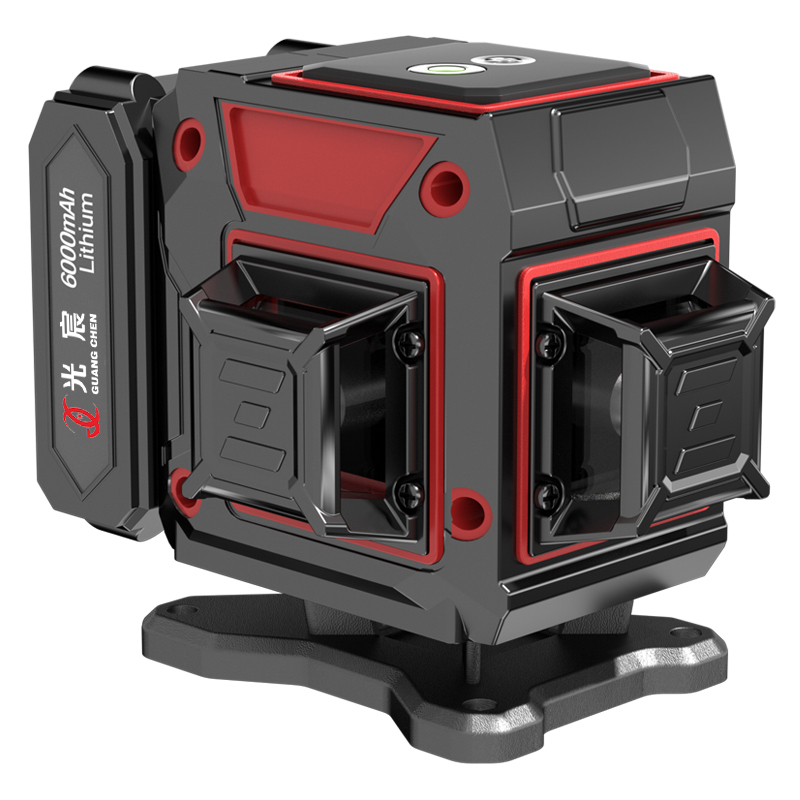 12-Line Self-Leveling Laser Level for Multi-Room Interior LayoutProjects four horizontal and eight vertical lines for cabinetry, tile, ceiling, partition, and framing tasks, covering multiple rooms from one tripod setup.View Product →
What no line laser does well is open slab work. The beam diverges and dims with distance, and glare off wet concrete kills the line beyond roughly 30 to 40 ft, so on a driveway, pad or foundation in the open, plan on a rotating beam with a detector for the main elevation control.
Accuracy, Tolerance and Where the Error Really Comes From
Spec-sheet accuracy is usually the smallest part of the error measured on a finished slab, so buy on the rest of the chain as well.
| Error source | Typical size | How to control it |
|---|---|---|
| Instrument spec | ±0.2 mm/m is about 1/16 in at 30 ft | Buy by need; laboratory accuracy rarely changes a slab |
| Tripod settling | Can reach 1/8 to 1/4 in on hot formwork | Set the tripod on a stable pad, not on rebar or fresh ply |
| Beam divergence | Roughly 1/16 in at 30 ft | Work at the shortest practical distance and mark the line center |
| Receiver deadband | ±1 to ±2 mm on most detectors | Use fine detection and confirm with a second pass |
| Thermal drift | Small but real over a long sunny pour | Re-check against a benchmark after long idle periods |
A Setup Routine That Keeps Lines True
A repeatable five-minute setup prevents almost every layout error that later shows up as a high or low spot in the pour.
- Place the tripod on firm, shaded ground 6 to 10 ft back from the busiest area, and check the head is roughly level before switching on.
- Let the instrument self-level undisturbed; if the beam blinks or the indicator stays red, the mount is outside the compensation range.
- Benchmark the height on a known point, then swing the instrument and confirm the same height on a second reference.
- Mark the center of the line, not its top or bottom edge, and snap or pencil the form from that mark.
- Re-check the benchmark after any pump truck, compaction or screed pass has shaken the ground nearby.
The same habits are described from a measurement angle in this guide to how to use a laser level correctly.
What to Check Before You Buy
Five practical details decide whether an instrument survives a concrete site, and they matter more than the headline accuracy figure.
- Beam color and pulse mode: green for interior visibility, plus a detector mode if you ever work outdoors.
- Self-leveling range and warning: ±4° is comfortable, anything under ±3° turns fussy on rough ground.
- Ingress protection: IP54 is a sensible minimum where dust and splash are constant.
- Mounting thread: confirm whether the base is 5/8 in-11, 1/4 in-20 or both, and that it fits your existing tripods.
- Plumb points above and below, which make floor-to-ceiling alignment possible from one setup.
 16-Line 3D Laser Level for Multi-Trade Interior Fit-OutProjects eight horizontal and eight vertical lines for wall, floor, and ceiling layout, with high-intensity beams and metal gear transmission suited to large interior fit-out.View Product →
A 16-line instrument covers the widest set of planes in a single setup, which suits multi-trade fit-out and large interior floor plates. For simpler work it is worth comparing the whole line laser range before paying for planes you will never switch on.
Frequently Asked Questions
Can a line laser replace a rotating laser on a slab?
No, not on an exterior or long-throw slab. A line laser is accurate but short and dim; beyond about 30 to 40 ft in daylight the beam cannot be seen reliably and a detector cannot pick up a static fan, so rotating beams handle elevation control across open ground.
What level accuracy do I actually need?
For most residential and light commercial slabs, ±0.3 mm/m is enough, because form setting and finishing tolerances are far looser. Tighter instruments earn their price when you set embeds, rail heights or machine bases where a few millimeters matter to the next trade.
Will a green beam work outdoors?
Only over short distances in shade. Green improves visibility indoors by roughly a factor of four, but sunlight overpowers even a bright green line at distance, so outdoor concrete work should rely on a rotating beam and detector.
How often does a laser level need calibration?
Treat it as an annual check in regular service, and as an immediate check after any drop or long, hot pour. A field test is simple: mark a point, rotate the instrument 180°, and compare beam height at the same distance.
Can I mount one on a screed or paver?
Not a handheld line laser, because machine motion and vibration never let a self-leveling pendulum settle. Machine-controlled screeds use a fixed transmitter with onboard receivers and a control loop built for that job.
Choosing a concrete laser level comes down to two questions: how far the beam must travel, and how bright the environment is. Answer those first, then pick between a compact line laser for interior layout and a rotating beam with a detector for open slabs, and keep your tripod and benchmark routine as disciplined as the tool itself.