English
 русский
 Español
 عربى
عربى
Imagine you are setting out a wall partition, installing kitchen cabinets, or laying ceramic tiles on a shower wall. A small error in the vertical or horizontal reference line becomes visibly worse at every joint you cut. A 90 degree laser level eliminates that guesswork by projecting a crosshair that is square by design. In short, a 90 degree laser level is a self-leveling tool that emits horizontal and vertical laser lines intersecting at exactly 90 degrees, letting you mark and align points quickly over distances that a traditional spirit level cannot cover in one step. This guide explains how these levels work, what features matter when buying one, and how to use them confidently on the job.
Content
What Is a 90 Degree Laser Level?
A 90 degree laser level is exactly what its name says: a laser instrument that projects two or more beams in a setup that creates right angles. The most basic model projects one horizontal line and one vertical line that cross at a right angle. More advanced models project multiple lines or 360-degree planes, but the 90-degree relationship between key lines remains the core function. Because the lines are generated from a calibrated pendulum or electronic sensor, the instrument can self-level within a specified range, typically 3 to 4 degrees. Once the tool settles, the projected lines stay accurate without manual adjustment.
| Model | Projected lines | Best suited for |
|---|---|---|
| 2-line | 1 horizontal + 1 vertical | Basic cross-line layout on one wall, cabinet and tile alignment |
| 3-line | 1 horizontal + 2 vertical | Corner transfer, vertical plumb checks on two adjacent walls |
| 5-line | 1 horizontal 360° + 2 vertical | Single-room layout, continuous horizontal line around walls |
| 8-line | 2 horizontal 360° + multiple vertical | Drop ceilings, partition walls, larger open spaces |
| 12-line and 16-line | Multiple 360° planes | Mechanical, electrical, and plumbing installation; floor-to-ceiling alignment; complex framing |
Most models also have a manual mode that locks the pendulum; in manual mode the lines blink or remain on but are not self-leveled. Manual mode is useful for aligning sloping surfaces such as stair rails or angled ductwork.
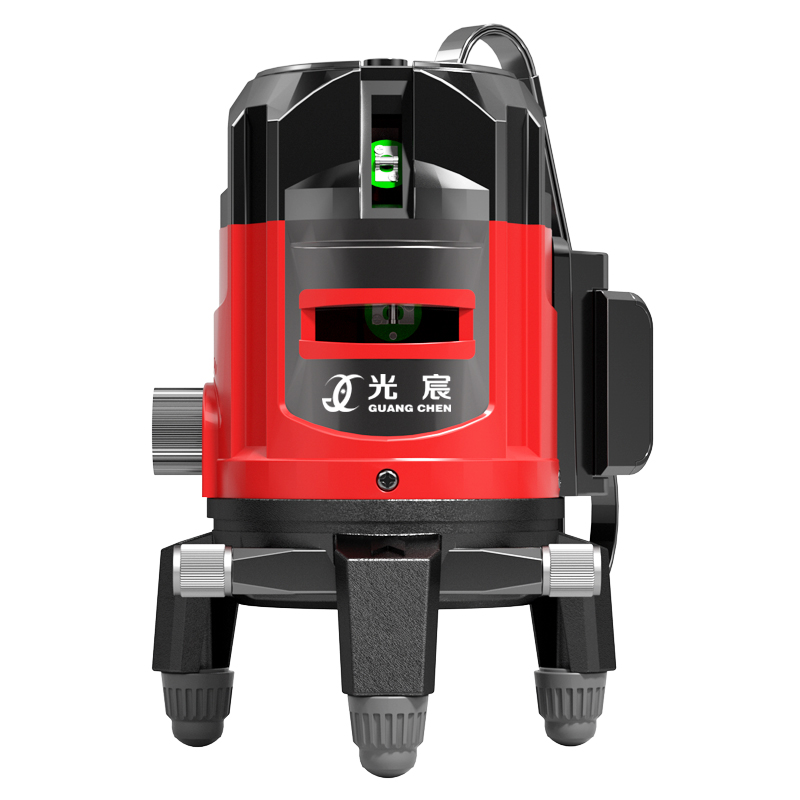 5-Line Self-Leveling Laser Level with 635nm BeamsThis 5-line model provides one horizontal and four vertical lines plus five enhancement points, ideal for indoor renovation where balancing coverage and cost matters. Its ±3° self-leveling and IP54 rating add practical value.View Product →
Choose a 90 degree laser level by matching line count, accuracy, and mounting features to the project size. For most indoor renovation work, a 5-line model strikes the best balance between coverage and price. It gives you the essential 90-degree cross plus additional vertical lines, so you can mark corners and transfer points without moving the tool. If the tool will be used on a large site or in open-plan spaces, consider an 8-line or 12-line model for 360-degree horizontal coverage.
Key specifications to check
- Accuracy: Look for within 0.2 mm per meter or better for most interior projects; 0.3 mm per meter is acceptable for basic framing.
- Self-leveling range: 3 to 4 degrees is common; a wider range makes setup easier on uneven surfaces.
- Laser class: Class 2 under 1 mW is safe for most indoor work; Class 3R requires extra caution.
- Beam visibility: Green lasers are roughly twice as visible as red lasers, but they consume more power and cost more.
- Battery life: Cordless levels with rechargeable Li-ion batteries are convenient; check runtime under normal operation.
- Mounting: A 5/8"-11 thread allows the level to be used on any standard tripod or pole mount.
- IP rating: IP54 or IP65 offers dust and splash protection for job-site conditions.
- Pulse or receiver mode: For outdoor use or long-distance layout, a receiver mode extends range to 30–50 meters.
Think about the surface where you will place the level. A product with a magnetic bracket or a rotating base can be attached to steel studs, conduit, or an adjustable tripod. For rooms with tight corners, a wider scanning angle reduces the number of times you need to reposition the tool. If you are evaluating different line configurations, you can compare the full range of 90 degree laser level models in one place.
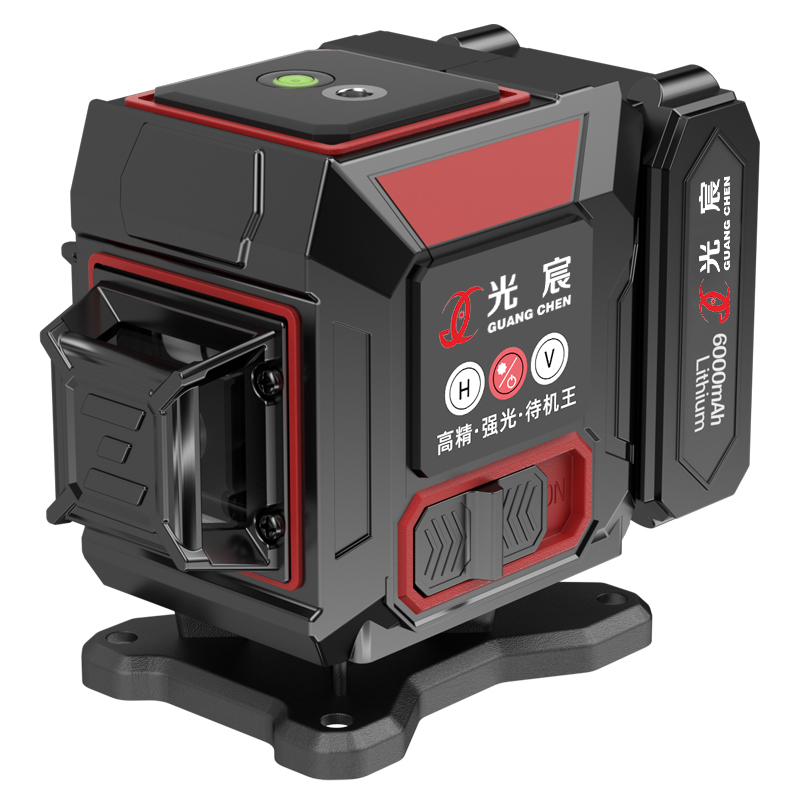 8-Line Precision Laser Level for Full Layout CoverageFeaturing four horizontal and four vertical lines, this tool suits larger sites and open spaces needing 360-degree horizontal coverage. Its accuracy and mounting compatibility make it a strong choice for complex square layouts.View Product →
Using a 90 degree laser level is quick when you follow a simple sequence: let it self-level, align one beam to a reference, then rotate the second beam to the target. Always wait for the beams to stop moving before marking; if the lines are still moving, the instrument has not locked its pendulum. For a right-angle layout, aim the vertical beam directly at a reference point such as a center line on the floor, then rotate the horizontal beam to align with the second wall. The intersection of the two beams is now your square point.
Basic step-by-step setup
- Place the level on a stable floor, tripod, or wall mount inside the self-leveling range.
- Turn the unit on and wait for the beams to stop moving.
- Align one beam with a known reference line or point.
- Rotate the instrument to project the second beam exactly where you need the 90-degree cross.
- Mark the laser line or points with a pencil while the beam is stable.
- Repeat on the adjacent wall by transferring the reference mark with the vertical beam.
Common applications include tiling, cabinet installation, partition walls, electrical outlet layout, window and door frames, drop ceilings, concrete formwork, pipe runs, and post spacing. For work beyond a single room, an 8-line model with a 360-degree horizontal plane lets you keep the tool in one position while you mark all four walls.
90 Degree Laser Level vs. Traditional Levels
A laser level cannot replace every manual measuring tool, but it absolutely replaces the most time-consuming part of layout: transferring level and plumb points across a room. A spirit level checks one line at a time; a 90 degree laser level checks two lines at once and from one setup. In a 3-meter-wide room, a bubble level needs to be repositioned many times, while a laser can mark a continuous line across the full width.
| Feature | Traditional spirit level or square | 90 degree laser level |
|---|---|---|
| Working range | Limited by length of the tool | Room-spanning, up to 30 m or more with receiver |
| 90-degree accuracy | Depends on square quality and user technique | Self-calibrated intersection |
| One-person operation | Awkward for long walls or high points | Easy to set and mark alone |
| Transferring to other surfaces | Requires additional tools and careful measurement | Vertical and horizontal beams mark floor, wall, and ceiling |
| Bright outdoor light | Readable in shade but not always in sun | Reduced visibility without receiver or green beam |
| Cost | Low initial cost | Higher, but saves time and reduces rework |
For more detail on how these tools compare in real work, the article on laser level precision and ease of use explains the practical differences in measurement and setup time.
Frequently Asked Questions
What does self-leveling mean on a 90 degree laser level?
Self-leveling means the laser uses an internal pendulum or electronic sensor to automatically adjust the beams until they are plumb and horizontal. As long as the unit is placed within its designed tilt range, you do not have to fine-tune it manually.
Can a 90 degree laser level be used outdoors?
Yes, but visibility drops in direct sunlight. A green beam model or a laser receiver is recommended for distances beyond 10 meters. In pulse mode, the receiver detects the beam and gives you an audible or visual readout.
What is the difference between a 2-line and a 5-line model?
A 2-line model projects one horizontal and one vertical line, giving you a single 90-degree cross. A 5-line model adds a 360-degree horizontal plane or extra vertical lines, so you can cover multiple walls and the ceiling without rotating the tool.
How accurate is a 90 degree laser level?
Most laser levels specify accuracy around 0.2 mm per meter for horizontal and vertical lines. At 5 meters, that means a deviation of about 1 mm, which is acceptable for most construction and remodeling work. Higher accuracy models are available for precision layout.
Do I need a receiver?
Only if you work outdoors, in bright light, or over distances beyond about 10 meters. A receiver extends the usable range of a 90 degree laser level to 30–50 meters and makes the beam readable on sunny job sites.
Bottom Line
A 90 degree laser level is a practical investment for anyone who needs to establish square, level, and plumb references quickly. Focus on accuracy, self-leveling range, visibility, and mounting options. For most general construction tasks, a 5-line model with a tripod mount and rotating head is a safe choice, while a 12-line or 16-line unit becomes worthwhile for larger framing and mechanical, electrical, and plumbing projects. If you also use the manual mode and a receiver for outdoor work, the same tool can cover a surprising amount of layout work on one battery charge.